TAILINGS & TSF APPLICATION
Tailings Dam Dust Suppression
Large-scale dust suppression applied across active and inactive tailings surfaces, with no personnel required on the tailings.
THE OPERATIONAL PROBLEM
Why dust control on a TSF is different
Tailings storage facilities create some of the largest continuously exposed and most erodible surfaces on a mine site. Beaches dry, fines mobilise, and a single wind event can put dust over a haul road, an accommodation village or a neighbouring landholder.
In most cases this is not a product problem. It is an access and application problem.
Large exposed surfaces
Beaches, inactive cells and embankments can run to hundreds of hectares. Treating them at a rate that stays ahead of the weather requires sustained daily coverage, not a single pass.
Fine, erodible material
Milled tailings mobilise readily once the surface dries. Crusting breaks down under traffic, fresh deposition and weathering, so dust control has to be planned as a cycle rather than a one-off treatment.
Access and bearing capacity
Soft, saturated and variable-strength surfaces limit where conventional plant can travel. The areas generating the most dust are frequently the areas a water cart cannot safely reach.
Personnel exposure
Putting operators and plant onto an active tailings surface introduces bogging, engulfment and rollover risk, and it is increasingly difficult to justify against a modern tailings management standard.
Application consistency
Coverage that varies across a large area shows up later as premature breakdown and re-treatment. Consistency across the whole treatment area matters more than peak application rate.
Weather and obligations
Wind constrains when application can occur. Licence conditions, air quality limits and community expectations do not move. The available working window is narrow and needs to be used well.
SAFETY BY DESIGN
Treat the surface without standing on it
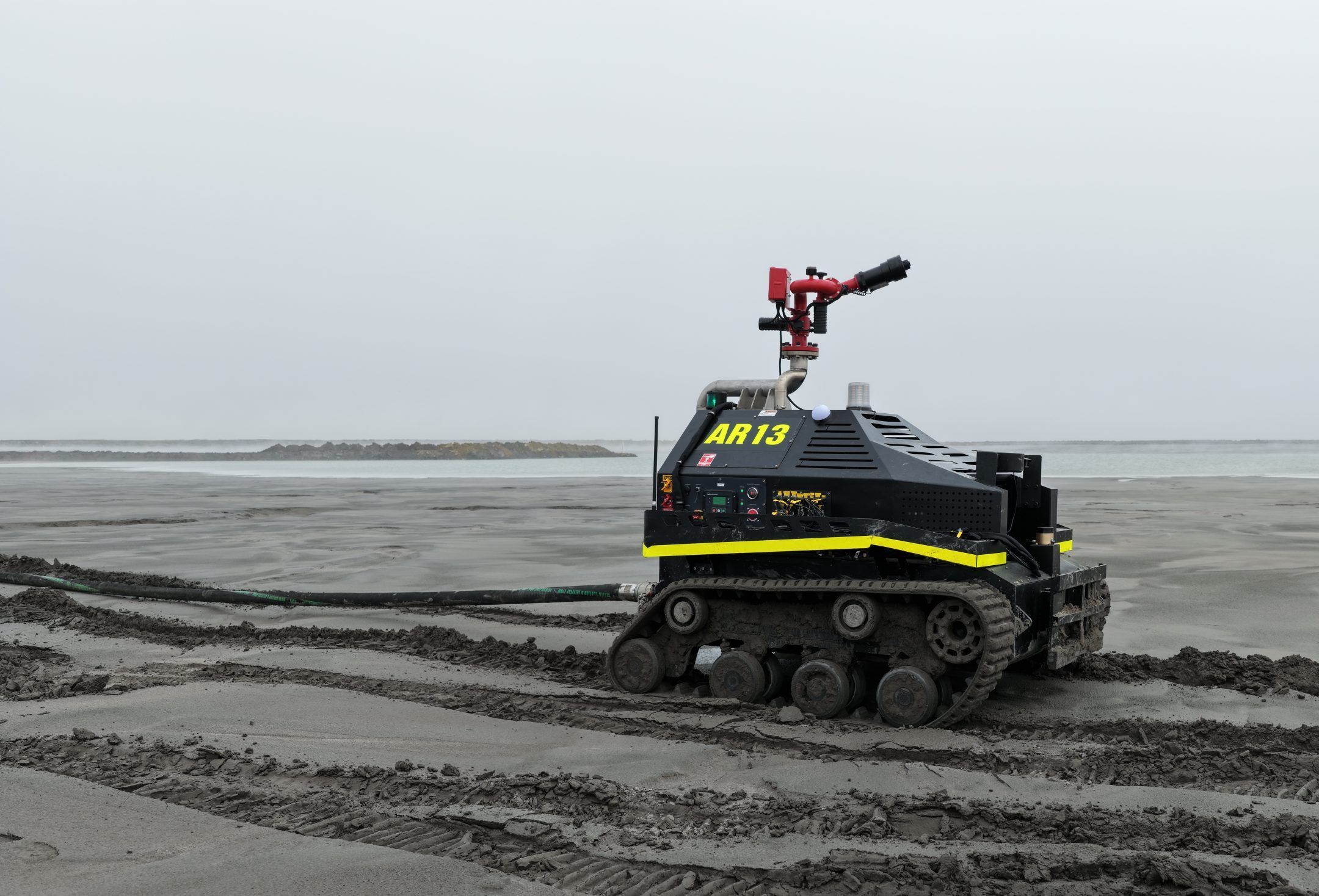
Avrik applies dust suppression to tailings using a remotely operated unmanned ground vehicle. The machine works the tailings surface while the crew stays on stable ground outside the treatment area.
Product is mixed and pumped from the perimeter and delivered to the machine by hose, so the operation does not depend on getting heavy plant onto the tailings. That removes the exposure normally associated with TSF application, along with the permits, spotters and rescue planning that exposure brings with it.
None
Personnel required on the active tailings surface
2
Operational personnel required to run the system
20 ha/day
Typical daily coverage
Actual production varies with treatment area, product, application rate and site access.
SEE HOW IT WORKS
How Avrik applies dust suppression across a TSF
The UGV is one part of an integrated application system. Removing people from the tailings surface only works if the supply, delivery and monitoring around the machine are built for the same job.

Unmanned ground vehicle
Purpose-built and remotely operated from outside the treatment area. The UGV runs interchangeable track systems, so the machine can be configured for the surface it has to work, from firm and trafficable through to soft, low-bearing tailings. Rated Excellent for terrain capability, soft-ground capability, coverage accuracy and application consistency in Avrik’s published application method comparison.
25,000L application trucks
Custom-built deployment trucks with multi-stage pumping systems mix and supply product from stable ground at the facility perimeter.
Hose infrastructure
High-capacity hose systems connect the trucks to the treatment area, providing reach across difficult terrain without tracking plant onto the tailings.
Monitoring and reporting
Integrated monitoring and aerial visibility give real-time oversight, application tracking and a record of what was treated and where.
APPLICATION CONTROL
Why the application method decides the result
Two sites can use the same product and get very different outcomes. On a tailings surface, the difference is almost always in how the product was applied.
- Coverage accuracy. Controlled ground speed and application width produce an even film. Uneven coverage fails first at the thinnest points and pulls the whole area back into the re-treatment cycle.
- Ground conditions. Low disturbance matters on a surface where trafficking damages the crust you have just paid to create.
- Product drift. Ground-based application close to the surface keeps product where it was intended rather than losing it downwind.
- Working window. Being able to keep applying in conditions that would stand a ground crew down converts more of the available window into treated hectares.
- Productivity. Sustained daily coverage determines whether a large facility is treated before conditions change, not how fast a single pass can be run.
- Accountability. Application data and imagery give the site a defensible record for regulators, communities and internal reporting.
TREATMENT SELECTION
Matching the treatment to the surface
No single dust suppression product suits every tailings surface. Selection depends on the substrate, the exposure and what the area has to do next.
- Tailings characteristics. Particle size distribution, mineralogy, salinity and how the surface behaves as it dries.
- Surface condition and trafficability. Whether the area must carry plant, remain undisturbed, or be progressively covered.
- Required treatment life. Short-term control through a summer, seasonal management, or a longer-term stabilised surface ahead of capping or rehabilitation.
- Project objective. Operational dust control, closure and rehabilitation, or an interim measure while other works proceed.
- Site constraints. Water availability and quality, environmental approvals, and products already accepted on site.
Avrik applies a range of dust suppression products and can work with a product your site has already approved. We recommend a treatment and an application programme once we understand the surface and the objective. Where a different application method suits the site better, we will say so.
COMPARE METHODS
UGV, HydroRig, aerial or hose application?
Most TSF dust programmes end up choosing between methods that each have a real operational limit: access, personnel exposure, drift, weather sensitivity or daily coverage. Compare them side by side against the criteria that matter on a tailings surface.
Select Three Application Methods
Explore Application Comparison
| Specification | UGV | HydroRig | Drone | Plane | Helicopter | Spray Bar | Hose |
|---|---|---|---|---|---|---|---|
| Typical Daily Coverage | 20 ha/day | 15 ha/day | 5–8 ha/day | 20 ha/day | 15 ha/day | 10 ha/day | 3 ha/day |
| Cost Efficiency | Excellent | Good | Good | Moderate | Poor | Very Good | Good |
| Safety Risk | Very Low | Medium | Low | Medium | Medium | High | High |
| Active Personnel on TSF | None | Required | None | None | None | Required | Required |
| Application Accuracy | High | Good | Good | Poor | Poor | High | Good |
WHY AVRIK
Application specialists, not equipment suppliers
- Built for this work. The UGV, the application trucks and the hose infrastructure were developed together for large-scale application on difficult ground, rather than adapted from general-purpose plant. Interchangeable track systems let the same machine be configured for very different surfaces.
- Large-scale application experience. Avrik has grown out of long-running large-scale application work across Australian mining, resources and civil operations. The technology is new; the application experience behind it is not.
- Compare the methods yourself. The table above sets the UGV against the alternatives on the measures that decide a job. The recommendation follows the site conditions, not the equipment we would prefer to mobilise. Where another method genuinely suits your surface better, we will say so.
- Evidence for the client. Monitoring, tracking and reporting give you a record of what was applied and where, which is useful for regulators, for the community and for your own reporting.
HOW WE ENGAGE
What a TSF dust programme looks like
Avrik is new to market with this technology, and we would rather show you how the work is planned than make claims about it. Most sites start with a defined trial area before committing to a full programme.
- 1. Site and surface assessment. Treatment area, beach condition, deposition history, bearing capacity, perimeter access, water availability and the dust source you are actually trying to control.
- 2. Method and treatment selection. Which application method suits the surface, which product suits the tailings, and what the treatment has to achieve: operational control, a seasonal window, or a surface ahead of capping.
- 3. Trial area. A defined area treated and monitored so the site can assess coverage, treatment behaviour and durability before scaling up. This is the fastest way to de-risk the decision.
- 4. Full application programme. Mobilisation, treatment plan, permits and inductions agreed with the facility owner, then sustained daily coverage across the nominated area.
- 5. Monitoring and reporting. Application tracking and aerial imagery giving a record of what was treated and where, for internal reporting and regulator or community enquiries.
COMMON QUESTIONS
Tailings dust suppression FAQ
Can the UGV work on soft or recently deposited tailings?
Soft ground is the reason the system exists. The UGV runs interchangeable track systems so it can be configured for the surface it has to work, and Avrik rates it Excellent for soft-ground and terrain capability in its application method comparison. Trafficability still varies with deposition history, beach slope and moisture, so we assess the specific surface before committing to a method or a programme.
Are the machines autonomous or remotely operated?
The units working on tailings today are remotely operated. An operator controls the machine from stable ground outside the treatment area, which is what removes personnel exposure on the surface. Autonomous units are in manufacturing. We will not describe a machine as autonomous on a client site until it is.
Does anyone need to go onto the tailings surface?
No. The UGV is operated remotely from outside the treatment area and product is supplied from the perimeter. Avrik’s published data lists no personnel required on the active TSF, with two operational personnel running the system from stable ground.
How much area can be treated in a day?
Avrik’s published typical daily coverage for UGV application is 20 hectares per day. Actual production depends on treatment area and shape, product, application rate, hose runs and site access.
What application rates do you use?
Application rates are set by the product selected, the tailings characteristics and the required treatment life, and are confirmed as part of the application programme. We do not quote a rate before assessing the surface.
How does wind affect the work?
Ground-based application close to the surface is far less wind-sensitive than aerial methods. Avrik rates UGV wind sensitivity and product drift risk as very low, which keeps more of the available working window usable.
How long does a treatment last?
Treatment life depends on the product, the application rate, the tailings surface and subsequent disturbance from traffic, fresh deposition and weather. Expected treatment life and any re-treatment requirement are set out in the proposal rather than assumed.
Can you treat inactive or closed facilities?
Yes. Dust control on inactive cells and closed facilities is usually a longer-term surface stabilisation question tied to closure and rehabilitation objectives, and treatment selection changes accordingly.
What is involved in mobilising to site?
Mobilisation covers the UGV, application trucks, hose infrastructure and operating crew, plus inductions, permits and a treatment plan agreed with the facility owner. Lead time depends on location, access and site requirements. Talk to us early if the work is tied to a seasonal window.
No personnel on the active surface
Two operators working from the perimeter, treating up to 20 hectares a day.
DISCUSS YOUR PROJECT
Tell us about your TSF
Send through the detail below and we will come back with a proposed application approach, an indicative programme and the questions we still need answered.
- TSF location and site access. Where the facility is and how the perimeter can be reached.
- Approximate treatment area. Hectares of exposed surface, and whether the cell is active or inactive.
- The dust issue you are managing. What is being affected, and what has already been tried.
- Surface and access constraints. Bearing capacity, beach condition, water availability, exclusion zones.
- Treatment period or project timing. Seasonal window, shutdown, closure milestone or approval deadline.
Prefer to talk it through? Call (08) 8183 0300 or visit our contact page. See the full range of Avrik dust suppression services, or read more on the technology behind the system on the Avrik story page.